

Pyramidal training is an endurance training distribution where most work is easy, some is moderate, and the smallest amount is hard. Learn how it compares with polarized training, what the evidence says, and how to use it with heart-rate zones.

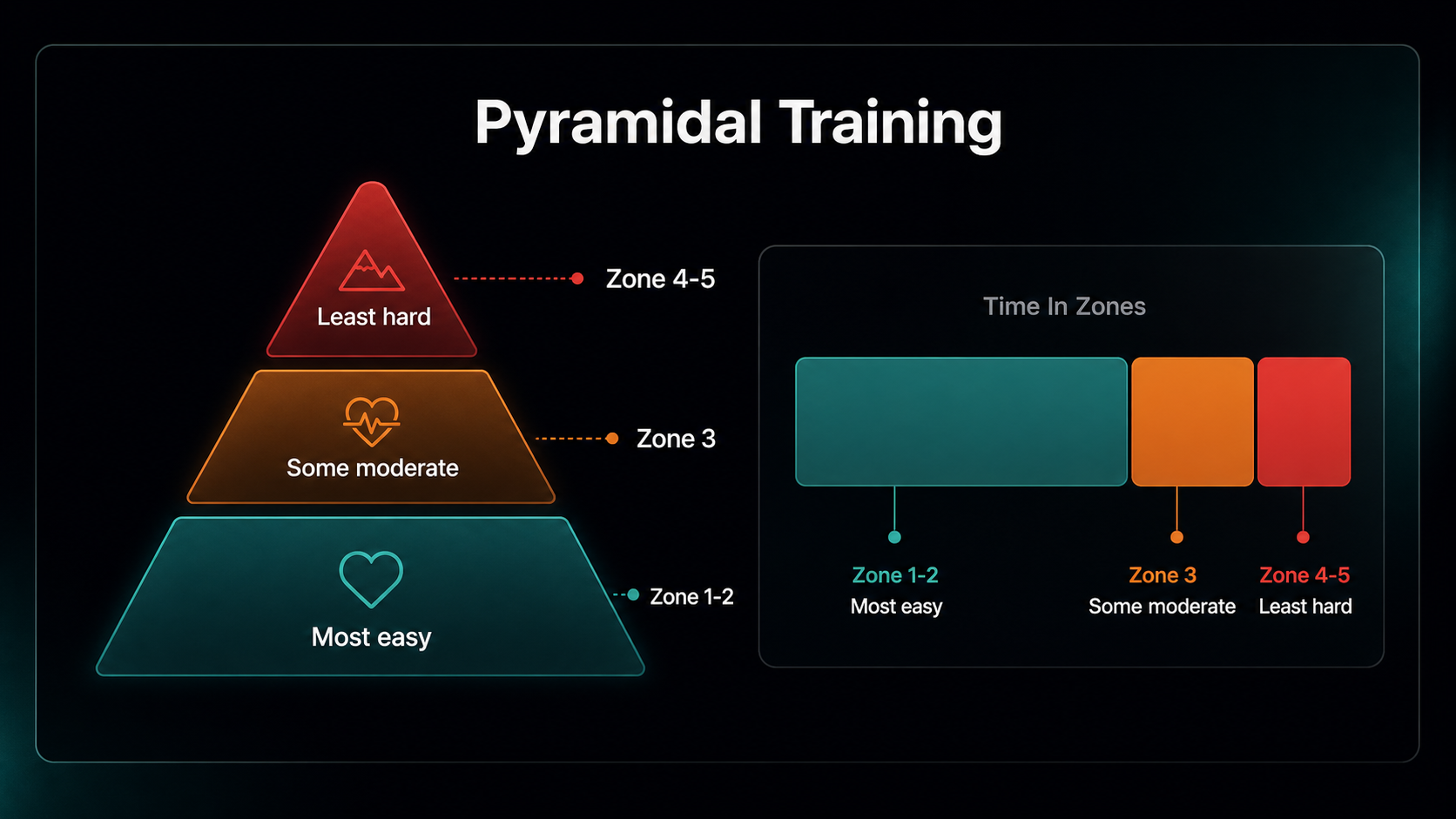
Pyramidal training is an endurance training approach where the largest share of work is easy, a smaller share is moderate, and the smallest share is hard. If you graphed weekly time in zones, it would look like a pyramid: a wide base of low-intensity volume, a narrower middle of controlled tempo or threshold-adjacent work, and a small top of high-intensity training.
For recreational endurance athletes, the idea is useful because it gives your week a clear shape without banning the middle zones. Easy sessions stay genuinely easy. Moderate work has a purpose. Hard efforts appear in small doses, not as the default setting for every workout.
Research on training intensity distribution often uses a three-zone model based on physiological thresholds. In that model, pyramidal training means Zone 1 is the biggest bucket, Zone 2 is smaller, and Zone 3 is smallest. A review of well-trained and elite endurance athletes described this low-intensity-heavy pattern as common across many successful endurance programs, while also showing that athletes shift the mix by sport, season, and goal (Frontiers in Physiology).
In a research setting, intensity zones are usually anchored to the first and second ventilatory or lactate thresholds:
| Research zone | Boundary | Plain meaning |
|---|---|---|
| Zone 1 | Below the first threshold | Easy aerobic work |
| Zone 2 | Between the first and second thresholds | Moderate, tempo, or threshold-supporting work |
| Zone 3 | Above the second threshold | Hard interval-style work |
Pyramidal training means the time or session distribution descends across those buckets: Zone 1 is highest, Zone 2 is next, and Zone 3 is lowest. In a five-zone heart-rate app, that usually looks like most weekly time in Zones 1-2, a meaningful but smaller amount in Zone 3, and the least time in Zones 4-5.
The shape is the point. Pyramidal training is not a workout where every interval gets harder, and it is not a weekly ladder where each day must be more intense than the last. It is a block-level pattern that keeps the easy base large while leaving room for planned moderate work and occasional high-intensity sessions.
Pyramidal and polarized training are often confused because both start with the same principle: most endurance training should be low intensity. The difference is what happens above the easy base.
In polarized training, the second-largest bucket is high intensity, and the moderate middle is kept relatively small. In pyramidal training, moderate work is larger than high-intensity work. So a polarized week might look like lots of easy work, a small amount of hard intervals, and very little Zone 3. A pyramidal week might look like lots of easy work, some tempo or threshold support, and a smaller amount of hard work.
Neither model says Zone 3 is automatically bad. The question is whether moderate work is planned and whether it fits the event. A marathon runner, long-course triathlete, cyclist preparing for sustained climbs, or hiker training for long grades may need more controlled moderate intensity than an athlete focused mainly on short high-power surges.
Threshold-heavy training is different again. In a threshold-heavy model, a large share of work sits around the middle intensity range. That can be useful for a specific block, but it can also become a recovery problem if easy volume shrinks and hard workouts lose quality.
The practical appeal of pyramidal training is that it matches how many endurance goals actually feel. Most athletes need enough easy volume to build durability and repeatability. They also need some sustained pressure: tempo running, steady climbing, race-pace riding, or controlled efforts that are not all-out. Pyramidal training gives that moderate work a place without letting it swallow the whole week.
It is also easier to apply than a strict 80/20 rule. If your watch shows five heart-rate zones, you do not have to treat every minute in Zone 3 as a mistake. You can ask a better question: was this moderate time intentional, and did the rest of the week stay easy enough to recover?
For many recreational athletes, pyramidal training also fits lower total training volume. If you train three to six hours per week, doing almost everything easy may not create enough sport-specific stimulus. A small amount of controlled moderate work can make the plan more productive, as long as it does not turn every session into the same steady-hard effort.
The evidence does not prove that pyramidal training is always superior. It does show that pyramidal distributions are common, plausible, and often effective in endurance sport.
Stephen Seiler's work helped popularize training intensity distribution as a way to understand endurance programs. His review on best practice in endurance training organization emphasized that successful athletes often perform a large amount of low-intensity training while using higher intensities more selectively (PubMed). Later reviews found that elite and well-trained endurance athletes frequently use either pyramidal or polarized patterns rather than training most sessions in the middle (Frontiers in Physiology).
Intervention studies are more mixed, which is useful to know. Filipas and colleagues studied well-trained endurance runners over 16 weeks and compared pyramidal and polarized intensity distributions. Both approaches improved performance-related outcomes, and the study reported that the optimal distribution may depend on the athlete and the training context rather than one universal formula (PubMed).
Elite rowing research points in the same pragmatic direction. Treff and colleagues compared pyramidal and polarized training in elite rowers during an 11-week preparation period and found performance improvements in both groups, without clear evidence that one distribution dominated in that setting (Frontiers in Physiology).
Running-specific reviews also urge caution. A systematic review on training intensity distribution and periodization in middle- and long-distance runners found that intensity distribution matters, but the available studies differ in athlete level, duration, event type, and how zones are counted (PubMed). More recent meta-analytic work continues to compare models such as polarized, pyramidal, threshold, and high-intensity distributions, which is a sign that the field is still refining when each model works best (PubMed).
The fair takeaway is simple: pyramidal training is a strong default when your event rewards sustained endurance and controlled moderate work. It is not proof that every athlete should train the same way all year.
Start by looking at your last two to four weeks, not one workout. A single hard climb or tempo finish does not define your training distribution. The weekly pattern does.
Use this basic audit:
| What your log shows | Likely interpretation |
|---|---|
| Most time in Zones 1-2 | Strong aerobic base |
| Zone 3 is smaller but visible | Pyramidal-leaning distribution |
| Zones 4-5 are the smallest bucket | Hard work is present but controlled |
| Zone 3 dominates the week | Possibly threshold-heavy or accidental moderate training |
| Zones 4-5 dominate the week | High-intensity-heavy block with high recovery cost |
A simple pyramidal week for a recreational athlete might include three easy sessions, one controlled tempo or progression workout, and one short interval or hill session. The exact sport does not matter as much as the shape: easy time is the base, moderate work is planned, and hard work is limited enough that you can repeat the week.
For example:
| Session | Purpose | Intensity |
|---|---|---|
| Easy aerobic | Build repeatable volume | Zones 1-2 |
| Tempo or progression | Controlled sustained pressure | Mostly Zone 3 |
| Easy aerobic | Recovery-friendly endurance | Zones 1-2 |
| Short intervals or hills | Neuromuscular or VO2max stimulus | Brief Zones 4-5 |
| Long endurance | Durability | Mostly Zones 1-2, small Zone 3 if terrain requires |
Do not force the numbers too tightly. Heart rate responds to heat, sleep, caffeine, terrain, dehydration, and sensor error. Use zone distribution as a trend tool, then pair it with perceived effort, recovery, and workout quality.
The first mistake is calling any pyramid "pyramidal training." A true pyramidal distribution still has an easy base. If most sessions feel moderately hard, the plan may be threshold-heavy rather than pyramidal.
The second mistake is using Zone 3 as the default pace. Pyramidal training includes moderate work, but that work should have a reason: tempo development, race-specific pacing, climbing strength, or controlled progression. If Zone 3 appears because every easy day drifted upward, it is not doing the same job.
The third mistake is avoiding hard work completely. Pyramidal training has less high-intensity work than moderate work, but it does not remove intensity. Short hill repeats, strides, intervals, or race-specific surges can still be useful when they fit your training age and recovery.
The fourth mistake is copying elite distributions without copying elite context. Elite athletes often train far more hours than recreational athletes, and their easy volume is part of a larger workload. A time-crunched athlete may need a different mix, especially during a specific preparation block.
Pyramidal training is an endurance intensity distribution built on a wide easy base, a smaller amount of moderate work, and the least amount of hard training. In practical five-zone terms, that usually means most time in Zones 1-2, some planned Zone 3, and a smaller dose of Zones 4-5.
The model is useful because it is disciplined without being dogmatic. It protects easy aerobic volume, gives moderate training a clear purpose, and keeps hard work small enough to recover from. Use it as a way to shape the week, not as a perfect spreadsheet target. If the pattern helps you train consistently, recover well, and make the workouts that matter better, it is doing its job.
Related


