Zone 2 training is steady aerobic work below your first major metabolic threshold. Learn what it is, why it matters, how to find your range, and how to use it without overcomplicating your training.

Zone 2 training is steady aerobic exercise done below your first major metabolic threshold. In plain language, it is the highest easy effort you can usually sustain while breathing under control and speaking in complete sentences. It is not sprinting, not tempo, and not a casual shuffle with no training purpose. It sits in the useful middle: easy enough to repeat often, hard enough to build aerobic capacity when you accumulate enough time.
Most people meet Zone 2 through a heart-rate watch. In a common five-zone heart-rate model, Zone 2 is often estimated around 60-70% of maximum heart rate. That estimate is convenient, but it is not the real definition. The more physiological definition is anchored near the first lactate threshold or first ventilatory threshold, often called LT1 or VT1. These thresholds mark the point where exercise is still mostly steady and aerobic, but the body is beginning to show a clear rise in lactate production, ventilation, and carbohydrate use.
That distinction matters because "Zone 2" is used loosely. Some coaches mean Zone 2 in a five-zone heart-rate model. Some research papers use a three-zone model where Zone 1 is below the first threshold, Zone 2 is between the first and second thresholds, and Zone 3 is above the second threshold. Some apps use age-based formulas. Some athletes use power, pace, or lactate testing. Before you compare your training to someone else's, you need to know which model you are using.
The practical goal is simpler than the terminology: Zone 2 helps you build the aerobic base that supports endurance, recovery, repeatability, and long-term training consistency. It is especially useful because you can do a lot of it without the recovery cost of high-intensity work. That does not mean Zone 2 is magic or that harder training is unnecessary. A 2025 narrative review in Sports Medicine argued that the evidence does not support Zone 2 as uniquely optimal for improving mitochondrial or fat oxidative capacity in the general population, especially when higher-intensity exercise is compared directly (PubMed). The best interpretation is more practical: Zone 2 is a core endurance tool, not the only tool.
This guide explains what Zone 2 is, what happens in your body during it, what benefits are well supported, what claims deserve caution, and how to find your own range with heart rate, breathing, lactate, power, pace, or perceived effort. It also includes a calculator so you can estimate a starting heart-rate range and then refine it with real training feedback.
Zone 2 training is controlled aerobic training that usually feels like a 3 to 4 out of 10 effort. You should be able to keep going for a long time, talk in complete sentences, and finish feeling like you could have done more. If you are gasping, chasing pace, or counting the seconds until the workout ends, you are probably above Zone 2.
For many recreational athletes, Zone 2 overlaps with easy running, steady cycling, brisk walking, hiking, rowing, swimming, or elliptical work. For a highly trained athlete, Zone 2 may be fast enough to look hard to an observer. For a deconditioned beginner, Zone 2 may be a walk with short hills, or even a mix of walking and easy jogging. The zone is relative to your body, not to the name of the activity.
A useful field definition is:
| Signal | What Zone 2 usually looks like |
|---|---|
| Breathing | Noticeably elevated but controlled |
| Speech | Full sentences are possible, singing is not |
| Effort | Easy to moderate, around 3-4 out of 10 |
| Duration | Sustainable for 30-90 minutes or longer once trained |
| Heart rate | Often near 60-70% HRmax, but varies by method |
| Power or pace | Below the first threshold, steady rather than surging |
| Recovery cost | Low to moderate if duration is appropriate |
The CDC describes the talk test for moderate-intensity aerobic activity as being able to talk but not sing, while vigorous activity makes it hard to say more than a few words without pausing (CDC). Zone 2 often lives near the upper end of that conversational range, though individual thresholds can vary.
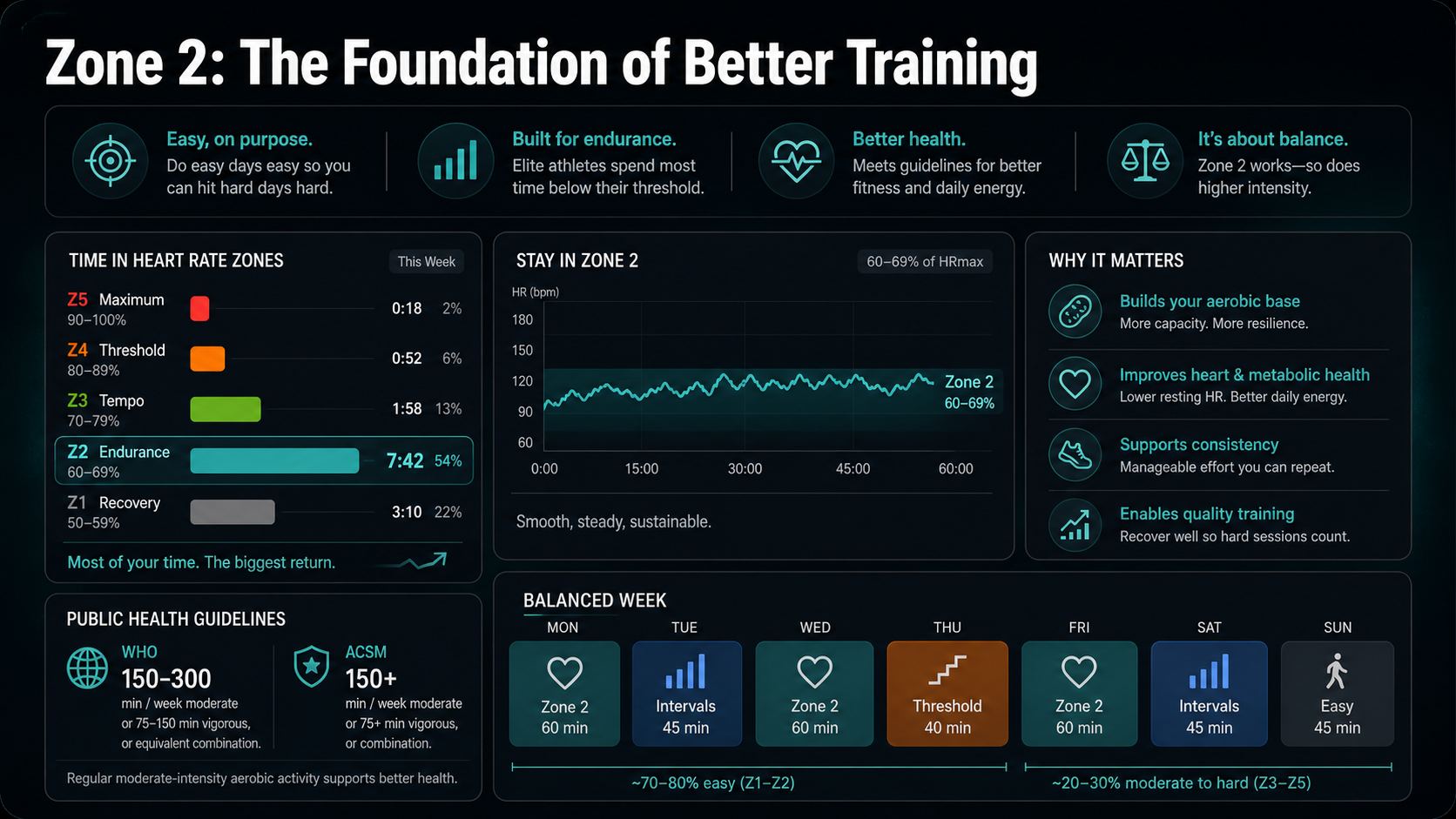
Zone 2 training became popular because it solves a real training problem: many people spend too much time in a vague moderate effort that feels productive but is too hard to recover from easily and too easy to replace true hard workouts. They do their "easy" days too hard, then cannot hit quality intervals with enough intent. Zone 2 gives those easy aerobic sessions a clearer target.
It also became popular because endurance athletes have long trained with large volumes of low-intensity work. Reviews of training intensity distribution in elite endurance athletes show that a large share of training time is often accumulated below the first ventilatory or lactate threshold, with smaller amounts of threshold and high-intensity work layered on top (PMC). This does not prove that everyone should copy elite volume, but it does show that low-intensity aerobic work is not filler. It is the foundation that makes larger training programs possible.
Zone 2 also fits modern health goals. Many people want better cardiovascular fitness, better metabolic health, lower resting effort during daily activity, and an exercise habit they can repeat without dreading it. Public-health guidelines do not use the term Zone 2, but they consistently recommend regular moderate-intensity aerobic activity. The WHO recommends that adults do 150-300 minutes of moderate-intensity aerobic physical activity per week, 75-150 minutes of vigorous activity, or an equivalent combination (NCBI Bookshelf). The American College of Sports Medicine gives a similar baseline recommendation for most adults: at least 150 minutes per week of moderate cardiorespiratory exercise, or 75 minutes of vigorous exercise, or a combination (PubMed).
Where popular Zone 2 advice sometimes goes too far is in claiming that this single intensity is uniquely superior for mitochondria, fat burning, longevity, or metabolic disease prevention. The evidence is more nuanced. Moderate steady training works. Higher-intensity training also works. The right mix depends on your goal, training history, available time, recovery capacity, and whether you are training for health, endurance performance, or both.
The body does not know the names of your zones. It responds to energy demand.
At very low intensities, oxygen delivery and energy demand are easy to match. Your muscles can produce most of the required ATP through aerobic metabolism. As intensity rises, carbohydrate use increases, lactate production rises, breathing gets faster, and the body works harder to keep internal conditions stable. At still higher intensities, the effort becomes less sustainable because lactate, hydrogen ions, inorganic phosphate, heat, and other fatigue-related signals rise faster than the body can manage them.
Exercise scientists often describe this progression with intensity domains and thresholds. A classic paper by Skinner and McLellan described the transition from aerobic to anaerobic metabolism as a staged process rather than a clean on-off switch (PubMed). More recent work also emphasizes that thresholds should be individualized because fixed percentages of maximum heart rate or VO2max can miss the actual metabolic boundary in a given person (PMC).
Zone 2 is usually intended to sit below or near the first threshold, not above the second. Below this first threshold, oxygen uptake and lactate can usually stabilize during a steady session. That is why Zone 2 can be sustained. You are working, but the system is not running away from itself.
Zone 2 is often explained as "training before lactate builds up." That phrase is useful, but it can create the wrong idea. Lactate is not simply a waste product. George Brooks and other researchers have spent decades showing that lactate is an important fuel, signaling molecule, and shuttle between tissues. A review by Brooks describes lactate as a central metabolic signal and notes that it is produced under aerobic conditions, not only when oxygen is absent (PMC).
During easy aerobic work, your body produces and uses lactate continuously. As effort rises, production increases. If clearance and oxidation keep pace, blood lactate can remain relatively stable. When production outruns clearance for long enough, lactate concentration rises more noticeably. Zone 2 training is useful partly because it lets you spend time near the point where your aerobic system is working meaningfully while still keeping lactate dynamics controlled.
This is also why a lactate meter does not automatically make training simple. Lactate thresholds depend on test protocol, step duration, sampling timing, recent diet, sleep, stress, and training status. A PLOS ONE study on graded exercise testing found that manipulating test variables can affect lactate threshold and VO2peak validity (PLOS ONE). Lab testing can be useful, but it is not immune to noise.
Zone 2 is often associated with fat oxidation. That association is real, but it is often oversimplified. At lower intensities, fat can supply a larger share of energy. As exercise intensity rises, carbohydrate becomes more important because it can support higher rates of ATP production. Romijn and colleagues used stable isotope tracers and indirect calorimetry to study how fat and glucose metabolism shift with intensity and duration (PubMed). Reviews of endurance substrate metabolism describe the same general pattern: prolonged endurance exercise depends on coordinated use of fat and carbohydrate, with increasing intensity shifting the balance toward carbohydrate (PMC).
This does not mean Zone 2 is a special "fat loss zone." Body-fat change still depends on total energy balance, diet, sleep, and adherence. Zone 2 can help because it is repeatable and can add meaningful weekly energy expenditure without crushing recovery. But the fat you oxidize during a single workout is not the same thing as long-term fat loss.
The strongest popular claim about Zone 2 is that it builds mitochondria. The cautious version is true: endurance training can increase mitochondrial content and function, and steady aerobic work is one route to that adaptation. The overconfident version is weaker: Zone 2 is not clearly the single best intensity for mitochondrial adaptation.
A systematic review and meta-regression covering exercise training effects on mitochondrial and capillary growth found that endurance training, high-intensity training, and sprint interval training can all improve mitochondrial content, capillarization, and aerobic capacity, with baseline fitness being a major driver of adaptation magnitude (PMC). MacInnis and Gibala's review of interval training similarly argues that high-intensity interval training can stimulate classic endurance adaptations, including increased aerobic capacity and mitochondrial content, often with lower time volume (PubMed).
The practical conclusion is not "skip Zone 2." It is "do not pretend Zone 2 is the only way the aerobic system adapts." Zone 2 is valuable because you can accumulate volume, keep recovery manageable, and train the low-intensity aerobic machinery consistently. Higher-intensity work can provide a potent stimulus too, but it is harder to repeat frequently and has a higher cost.
One of the easiest ways to misunderstand Zone 2 is to mix zone systems.
In the five-zone system used by many watches and apps, Zone 2 often means the second band out of five. A simple version is:
| Five-zone label | Common percent of HRmax | Typical feel |
|---|---|---|
| Zone 1 | 50-60% | Very easy |
| Zone 2 | 60-70% | Easy aerobic |
| Zone 3 | 70-80% | Moderate or tempo |
| Zone 4 | 80-90% | Hard threshold-style |
| Zone 5 | 90-100% | Very hard to maximal |
This model is easy to use but crude. The American Heart Association lists moderate-intensity activity at about 50-70% of maximum heart rate and vigorous activity at about 70-85% (American Heart Association). That public-health model overlaps with the lower heart-rate zones, but it is not the same as a threshold-tested endurance model.
In a three-zone research model, the zones are often arranged around physiological thresholds:
| Three-zone label | Boundary | Plain meaning |
|---|---|---|
| Zone 1 | Below LT1 or VT1 | Low-intensity aerobic work |
| Zone 2 | Between LT1 or VT1 and LT2 or VT2 | Threshold or heavy aerobic work |
| Zone 3 | Above LT2 or VT2 | High-intensity work |
This creates a language problem. What many runners call "Zone 2" in a five-zone app may be "Zone 1" in a three-zone research paper. That is why the phrase "80% Zone 2" can be misleading if the model is not named. In much of the endurance training literature, the low-intensity volume that elite athletes accumulate is below the first threshold. In a five-zone consumer model, that may correspond mostly to Zones 1 and 2.
For this article, Zone 2 means the common five-zone coaching concept: controlled easy aerobic work near but below the first meaningful threshold.
Zone 2 is useful because it lets you train the aerobic system with a favorable ratio of stimulus to fatigue. The benefits below are the ones worth caring about.
The aerobic base is your ability to produce energy with oxygen over long periods. It shows up as lower effort at a given pace, better endurance late in a workout, faster recovery between surges, and more capacity to handle total training volume.
Low-intensity aerobic training has long been a major part of endurance programs. The review on training intensity distribution among well-trained and elite athletes describes high-volume low-intensity work as a dominant feature in many endurance sports, while also noting that athletes combine it with threshold and high-intensity training depending on sport, season, and goals (PMC). This is the best way to think about Zone 2: it is the base layer, not the whole program.
For beginners, the aerobic base may simply mean being able to walk briskly, climb stairs, or run continuously without feeling overwhelmed. For cyclists, it may mean holding a steady power for an hour without heart rate drifting too high. For runners, it may mean easy mileage that does not wreck the next day. For strength-focused athletes, it may mean better conditioning between sets and less fatigue during daily life.
Hard training is powerful, but limited. You cannot do maximal intervals every day and expect the body to adapt indefinitely. Zone 2 solves a different problem: it gives you a way to add meaningful aerobic work while preserving recovery.
This is why easy aerobic work appears so often in endurance training. A runner who can do four hard workouts per week on paper may still perform better with two hard workouts and several easier aerobic sessions. The easy sessions build volume, support recovery, and preserve quality for the harder days. This is also why the "easy days easy, hard days hard" idea has survived across sports.
Zone 2 does not need to feel heroic to work. In fact, if every Zone 2 session feels heroic, the session is probably too hard, too long, or placed poorly in the week.
Durability is the ability to maintain performance as fatigue accumulates. It is what keeps your heart rate, breathing, posture, and pace from falling apart late in a long ride or run.
Zone 2 helps durability because it is often where you can practice sustained output for long enough to expose the aerobic system to time. You learn how your heart rate drifts, how heat affects you, how fueling changes a session, and how your easy pace changes as you get fitter. Over weeks and months, that repeated exposure can make longer workouts feel less fragile.
Durability is not just a racing concept. It matters if you want a hike to feel good, if you want to play with your kids without being winded, if you want a long bike commute to feel normal, or if you want to enter a training block without getting buried by the first month.
Zone 2 and high-intensity training are often framed as opposites. In practice, they complement each other.
A better aerobic base can help you recover between hard intervals, tolerate more total work, and arrive at quality sessions less fatigued. High-intensity work can raise VO2max, improve power, and provide adaptations that steady low-intensity work may not maximize. Stoggl and Sperlich compared polarized, threshold, high-intensity, and high-volume training concepts in well-trained endurance athletes and found that polarized training improved several key endurance variables, though the result should be interpreted in the context of trained athletes and the specific intervention design (PMC).
Other research is less absolute. A systematic review and meta-analysis comparing polarized versus other endurance training intensity distributions found mixed results depending on intervention length, athlete level, and outcome (PMC). The lesson for most people is not that there is one perfect distribution. It is that a program with enough easy aerobic work and some deliberate intensity is usually more robust than a week full of accidental medium-hard sessions.
The best workout plan is not the most impressive plan you can tolerate for two weeks. It is the plan you can repeat long enough to adapt.
Zone 2 is less intimidating than maximal intervals and more structured than "just move more." That makes it a strong entry point for people who want a repeatable routine. The ACSM position stand notes that exercise that is pleasant and enjoyable can improve adoption and adherence to prescribed exercise programs (PubMed). That matters. If Zone 2 feels manageable, you are more likely to do it often enough for it to matter.
Zone 2 is not a medical treatment, and this article is not medical advice. But regular aerobic activity is strongly associated with better health outcomes. The WHO guideline chapter summarizes evidence that physical activity in adults confers benefits for all-cause mortality, cardiovascular disease mortality, hypertension, type 2 diabetes, mental health, cognitive health, sleep, and adiposity measures (NCBI Bookshelf).
Cardiorespiratory fitness itself is also a powerful health marker. An overview of meta-analyses covering more than 20.9 million observations found that higher cardiorespiratory fitness is consistently associated with lower risk of multiple adverse health outcomes, including all-cause mortality and cardiovascular outcomes (PMC). Zone 2 can be one practical way to build the aerobic work that supports cardiorespiratory fitness, especially for people who need a sustainable starting point.
That said, health-focused training does not need to be Zone 2 only. The 2025 Sports Medicine review cautioned against telling the general public to forgo higher intensities entirely, because higher-intensity exercise may be important for maximizing some cardiometabolic benefits when total training volume is low (PubMed). For health, a smart plan often includes moderate aerobic activity, some vigorous work if appropriate, and resistance training.
Zone 2 has enough evidence behind it to be useful, but not enough to support every claim made about it. This section separates the grounded claims from the hype.
This is well supported. Many endurance athletes spend a large share of training time below the first threshold. Esteve-Lanao and colleagues compared training programs in subelite endurance runners over five months and examined the impact of emphasizing low-intensity work versus more time in the threshold region (PubMed). The broader training intensity distribution literature consistently treats low-intensity volume as a major component of endurance preparation (PMC).
But there is a key caveat: elite athletes are not average exercisers. They often train many more hours, have years of adaptation, and use easy volume partly because they have to manage the recovery cost of a large training load. A recreational athlete with three hours per week should learn from elite principles, not copy elite volume.
This is practically true and central to why Zone 2 works. The evidence for exercise intensity distribution supports the idea that endurance programs benefit from balancing low-intensity volume with harder work. The mechanism is not mysterious: low-intensity work lets you accumulate time, practice movement, and train aerobic metabolism with less acute fatigue than threshold or interval sessions.
The word "relative" matters. A 90-minute Zone 2 run can still be stressful if you are new, underfueled, injured, or sleep-deprived. Zone 2 is low cost compared with hard intervals at the same duration, not zero cost.
This is plausible and broadly supported as part of endurance training, but the intensity-specific claim is more complicated. Endurance training can improve mitochondrial content and aerobic metabolism. However, reviews of interval training and mitochondrial adaptation show that higher-intensity work can produce similar or stronger mitochondrial signals, particularly when compared by time efficiency or matched work (PubMed). The systematic review on mitochondrial and capillary growth also found meaningful adaptations across endurance, high-intensity, and sprint interval training modes (PMC).
The safe wording is: Zone 2 can contribute to mitochondrial and aerobic adaptations, especially because it is repeatable and supports volume. It is not proven to be uniquely superior to every harder intensity for mitochondrial adaptation.
Zone 2-style training can improve the body's ability to use fat during aerobic exercise, especially as part of broader endurance adaptation. It is also true that fat oxidation tends to be higher at moderate intensities than at very high intensities. A review on maximal fat oxidation describes the relationship between intensity and fat oxidation as generally parabolic: fat oxidation rises with intensity up to a point, then falls at high work rates (PMC).
The overclaim is that Zone 2 is automatically the best way to lose body fat. It is not. Fat loss depends on energy balance over time. A Zone 2 session may burn a higher proportion of fat than a hard interval session, but a harder session may burn more total energy per minute. The best method is the one that supports your weekly consistency, recovery, appetite control, and total training plan.
This is not supported. Zone 2 is useful, but a blanket "mostly Zone 2 for everyone" claim ignores time availability, goals, baseline fitness, medical context, and adaptation to training. Public-health recommendations include both moderate and vigorous options. Research on interval training shows that high-intensity work can be time-efficient and effective for improving cardiorespiratory fitness and metabolic outcomes (PMC).
For a busy person with two 30-minute slots per week, some higher-intensity training may be valuable if it is safe and tolerated. For a runner building toward a marathon, Zone 2 and easy aerobic volume may dominate because the sport demands it. For a cyclist training ten hours per week, a lot of low-intensity riding makes sense. For someone returning from illness or managing a chronic condition, intensity decisions should be individualized with medical guidance.
There are several ways to estimate Zone 2. None is perfect. The goal is to combine them until your range behaves correctly in real workouts.
The most precise route is a graded exercise test that measures lactate, ventilation, or both. A lab may identify LT1, VT1, LT2, VT2, VO2max, and the heart rate or power associated with each point. This can be useful if you are serious about endurance performance or if your watch zones do not match how you feel.
The upside is individualization. The downside is cost, access, protocol variability, and the fact that your thresholds can change with training, detraining, sleep, stress, nutrition, and sport. If you test on a bike, the results may not transfer cleanly to running. If you test after poor sleep, the result may be noisier. Lab data is useful, not sacred.
The talk test is the simplest field method. During Zone 2, you should be able to speak in complete sentences without gasping. You should not be able to sing comfortably. If you can only say a few words at a time, you are likely too high. The CDC uses a similar talk-test distinction for moderate versus vigorous physical activity (CDC).
For many people, this is more reliable than a formula. A watch may call a run Zone 2, but if you cannot speak, the session is not easy aerobic work. Conversely, a fit athlete may exceed a generic percent-of-HRmax Zone 2 range and still be below VT1. Breathing and speech keep the heart-rate number honest.
The common starting estimate is 60-70% of maximum heart rate. If your maximum heart rate is 185 bpm, that gives:
| Calculation | Result |
|---|---|
| 185 x 0.60 | 111 bpm |
| 185 x 0.70 | 130 bpm |
That would estimate Zone 2 at about 111-130 bpm.
This method is simple, but it depends on knowing your real maximum heart rate. Age-based estimates can be wrong for individuals. Tanaka, Monahan, and Seals proposed 208 - 0.7 x age after analyzing measured maximum heart rate data from 351 studies and validating the equation in a laboratory sample (JACC). It is better supported than the old 220 - age rule, but it is still a population estimate.
Heart-rate reserve uses the range between resting heart rate and maximum heart rate:
heart-rate reserve = HRmax - HRrest
target heart rate = (heart-rate reserve x intensity) + HRrest
This method is commonly associated with Karvonen, Kentala, and Mustala's 1957 work on training and heart rate (PubMed). It often gives a higher Zone 2 estimate than simple percent of HRmax for people with low resting heart rates, because it accounts for the usable range between rest and max.
Example:
| Input | Value |
|---|---|
| Maximum heart rate | 185 bpm |
| Resting heart rate | 55 bpm |
| Heart-rate reserve | 130 bpm |
| 60% HRR | 133 bpm |
| 70% HRR | 146 bpm |
Using HRR, Zone 2 might be 133-146 bpm. Using simple percent of HRmax, the same person might get 111-130 bpm. That is a large difference, which is why you should not mix methods without noticing.
Use the calculator below to estimate a practical starting range. The standalone version is also available at the Zone 2 Heart Rate Calculator.
Cyclists often use power because it responds immediately to effort. Runners use pace, but pace is more affected by terrain, wind, surface, heat, and fatigue. Power and pace can still help if you calibrate them to testing or repeated workouts.
For cycling, Zone 2 power is often treated as endurance power below threshold. For running, Zone 2 pace is the pace that lets breathing stay controlled for a long time. The trap is chasing last week's pace when today's body is not in the same condition. Heat, poor sleep, dehydration, caffeine, stress, and hills can push heart rate higher at the same pace or power.
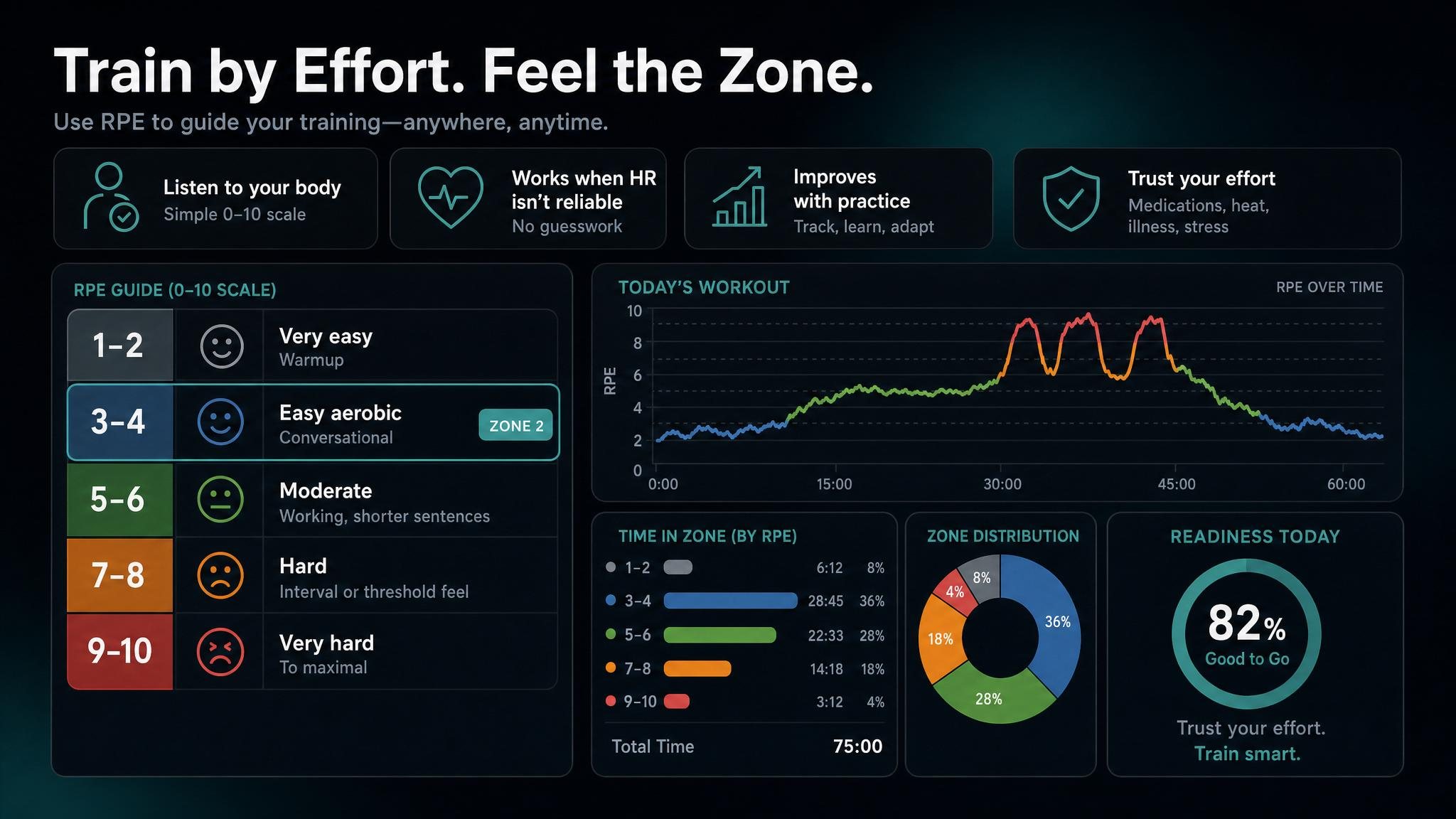
Rate the effort from 0 to 10. Zone 2 usually feels like 3 to 4:
| RPE | Feel |
|---|---|
| 1-2 | Very easy, warmup |
| 3-4 | Easy aerobic, conversational |
| 5-6 | Moderate, working, shorter sentences |
| 7-8 | Hard, interval or threshold feel |
| 9-10 | Very hard to maximal |
RPE is subjective, but it improves with practice. It is also useful when heart-rate data is unreliable because of wrist-sensor error, medication, heat, illness, or unusual stress.
Zone 2 should feel almost suspiciously manageable when you start. You may wonder whether it is too easy. That is normal, especially if you are used to turning every cardio session into a challenge.
Use these cues:
| Cue | Good Zone 2 sign | Too hard sign |
|---|---|---|
| Breathing | Controlled, rhythmic | Sharp, strained, or mouth-only gasping |
| Speech | Full sentences possible | Only short phrases possible |
| Focus | You can think clearly | You need to concentrate to hold on |
| Muscles | Working but not burning | Heavy, burning, or urgent |
| Heart rate | Stable after warmup | Keeps climbing quickly at steady output |
| Finish | You could continue | You are relieved it is over |
Do not judge Zone 2 by speed alone. A true Zone 2 session may be slower than your ego wants. That is especially true for runners, because running has a minimum mechanical cost. If you are newer to running, your Zone 2 may require run-walk intervals. That is not failure. It is accurate training.
Cyclists often find Zone 2 easier to control because power can be adjusted smoothly. Runners often have to accept that hills, heat, and wind will change the pace. Swimmers may use breathing pattern and perceived exertion more than heart rate because wrist heart-rate readings in water can be unreliable. Rowers may use stroke rate and split, but should still check breathing.
The right amount depends on your goal and current capacity.
If you are training for general health, start by meeting the baseline aerobic activity guidelines. The WHO and ACSM both point to roughly 150-300 minutes of moderate-intensity aerobic activity per week, or a smaller amount of vigorous work, for substantial health benefits (NCBI Bookshelf, PubMed). Zone 2 can provide much of that moderate aerobic work.
If you are a beginner, two or three Zone 2 sessions per week may be enough to start:
| Level | Starting target |
|---|---|
| Deconditioned or returning | 2-3 sessions of 15-30 minutes |
| Recreational exerciser | 3-4 sessions of 30-60 minutes |
| Endurance-focused athlete | 3-6 sessions, often 45-120 minutes |
| High-volume athlete | Most weekly volume may be easy aerobic work |
Progress gradually. Add time before intensity. If you are already doing hard workouts, replace some accidental moderate work with Zone 2 rather than simply piling more training on top.
A simple progression:
For many people, three 45-minute Zone 2 sessions plus one short higher-intensity session is more sustainable than trying to do five hard cardio workouts. For a runner preparing for a race, Zone 2 may sit inside a broader plan that includes strides, tempo, threshold, race-pace work, long runs, and strength training.
A useful Zone 2 session is long enough to accumulate steady aerobic time but short enough that it does not compromise the rest of your week.
For beginners, 20-30 minutes can be meaningful. For recreational athletes, 30-60 minutes is a common working range. For endurance athletes, 60-120 minutes or longer may be normal depending on sport and training phase.
The warmup matters. Heart rate often rises gradually during the first 5-15 minutes. Do not sprint into your Zone 2 range. Start below it, let breathing settle, then ease into the target. If your heart rate drifts upward late in the session while pace or power stays the same, decide whether to slow down or cap the session. Some drift is normal. A lot of drift may mean heat, dehydration, insufficient fueling, poor sleep, or too much duration for your current fitness.
For most people, it is better to finish a little undertrained than to turn Zone 2 into a hidden threshold workout.
Use these as templates, not commandments.
| Segment | Prescription |
|---|---|
| Warmup | 5 minutes easy walking |
| Main set | 20 minutes brisk walk or 1 minute easy jog / 2 minutes walk |
| Cooldown | 5 minutes easy walking |
| Target | Able to talk in sentences |
If your heart rate rises too high when jogging, walk. If walking on flat ground is too easy, add a gentle hill or increase pace slightly.
| Segment | Prescription |
|---|---|
| Warmup | 10 minutes very easy |
| Main set | 35-50 minutes Zone 2 |
| Optional | 4 x 15 seconds relaxed strides after the run |
| Cooldown | 5 minutes easy |
Keep the main set conversational. If you add strides, they should feel relaxed and fast, not like intervals.
| Segment | Prescription |
|---|---|
| Warmup | 10-15 minutes easy spinning |
| Main set | 60-90 minutes steady Zone 2 power or heart rate |
| Cooldown | 5-10 minutes easy |
Avoid surging every time the road opens up. If you ride with others, choose a group that lets you stay in the target range.
| Segment | Prescription |
|---|---|
| Warmup | 5-10 minutes easy |
| Main set | 25-40 minutes bike, incline walk, rower, or elliptical |
| Cooldown | 5 minutes easy |
| Placement | After lifting or on separate easy days |
Use a modality that does not beat up the joints you need for lifting. For many lifters, cycling or incline walking is easier to recover from than running.
| Day | Session |
|---|---|
| Monday | Zone 2, 35 minutes |
| Wednesday | Short interval or hill session |
| Friday | Zone 2, 45 minutes |
| Weekend | Optional Zone 2, 45-75 minutes |
This gives you a base of easy aerobic work plus one higher-intensity stimulus. It is not a perfect plan for every goal, but it is a strong general template.
Running makes Zone 2 emotionally difficult because pace is visible. You may need to run slower than expected. You may need to walk hills. You may need to ignore people passing you.
That is the point. Easy running is not a performance test. It is aerobic work.
Common running mistakes include:
| Mistake | Fix |
|---|---|
| Chasing a pace from cooler weather | Use effort and heart rate in heat |
| Refusing to walk hills | Walk or shorten stride to stay aerobic |
| Treating every group run as Zone 2 | Choose routes and partners carefully |
| Running Zone 2 too soon after hard sessions | Add recovery or cross-train |
| Using wrist HR without checking accuracy | Tighten watch or use a chest strap |
If your Zone 2 run pace feels embarrassingly slow, do not panic. As aerobic fitness improves, the same heart rate may support a faster pace. That improvement can take weeks or months. The early win is learning to control intensity.
Cycling is well suited to Zone 2 because power and effort are easier to modulate. You can ride below threshold for long periods without the impact cost of running.
The main cycling mistake is surging. A ride that averages Zone 2 but includes repeated hard climbs, accelerations, and town-line sprints is not the same as a steady aerobic ride. That does not make it bad, but it makes it a different workout.
Use power if you have it, heart rate if you trust it, and breathing either way. On long rides, fuel enough to avoid turning the final third into a stress test. Zone 2 does use fat, but it does not mean you should avoid carbohydrate, especially if the ride is long or you have harder training nearby.
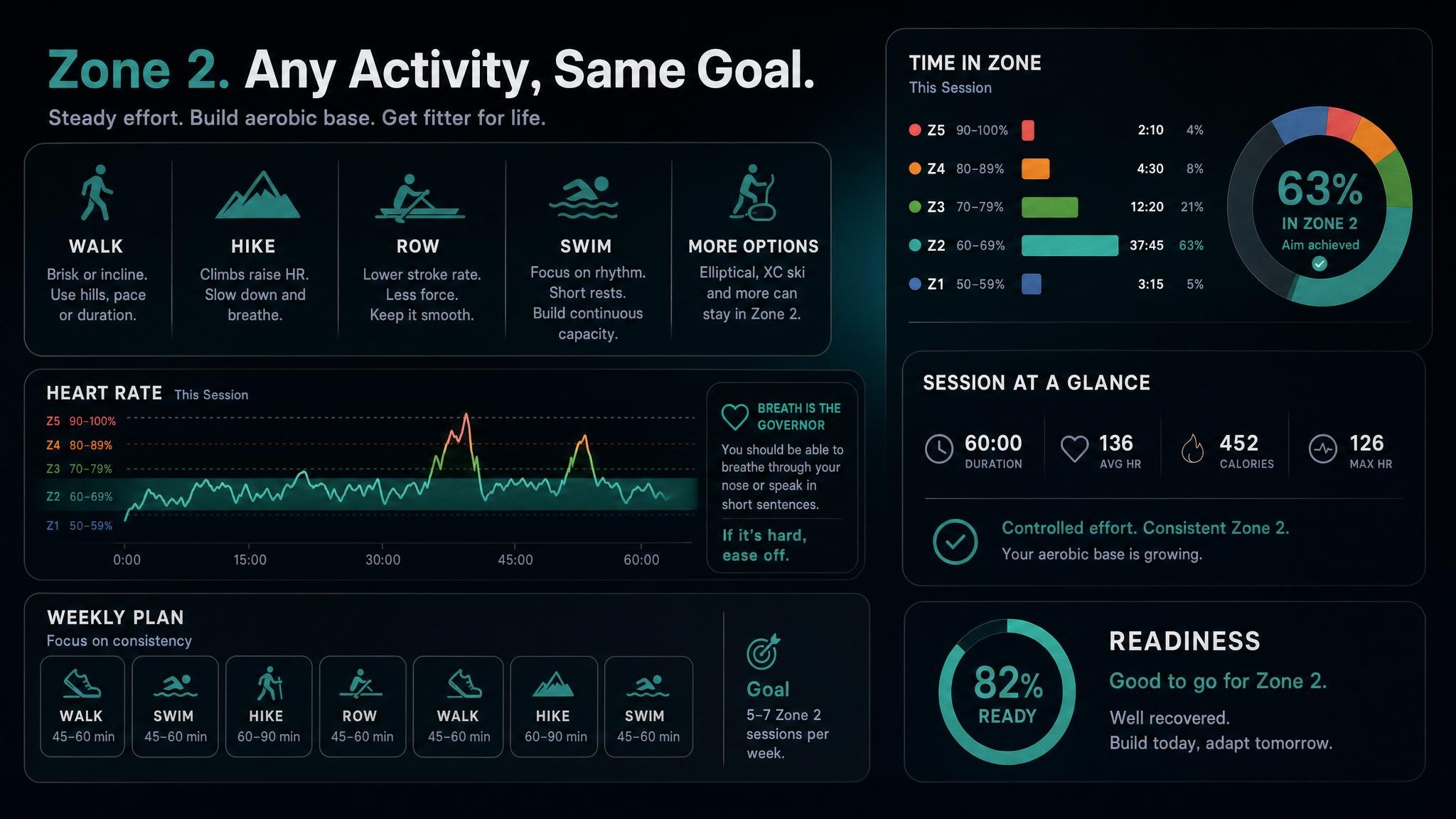
Zone 2 does not require running or cycling. Brisk walking, incline treadmill walking, hiking, rowing, swimming, elliptical training, and cross-country skiing can all work.
Walking is underrated. For beginners, older adults, people returning from injury, and strength athletes who do not want extra impact, brisk walking or incline walking can provide controlled aerobic work. If flat walking does not raise effort enough, hills, incline, pace, poles, or a longer duration can help.
Hiking often turns into mixed-intensity training because climbs push effort up and descents lower it. That is fine, but if the goal is strict Zone 2, slow the climbs and use breathing as the governor.
Rowing can drift above Zone 2 quickly because it involves a lot of muscle mass. Lower the stroke rate, reduce force, and keep the session smooth.
Swimming Zone 2 is mostly about rhythm. If you need long breaks every length, the session is not steady aerobic work yet. Use shorter repeats with easy recovery and gradually build continuous capacity.
Zone 2 is simple, but people still make predictable mistakes.
The most common mistake is turning Zone 2 into Zone 3. It happens because moderate effort feels more satisfying. The workout feels like "real training," pace looks better, and the athlete finishes with a sense of accomplishment. The problem is that repeated moderate-hard sessions can quietly raise fatigue without providing the same stimulus as true high-intensity work.
If your Zone 2 workout requires concentration to survive, it is too hard. Slow down.
Heart rate is useful, but it is not the body. It changes with heat, hydration, caffeine, medication, sleep, stress, altitude, illness, and sensor quality. A fixed Zone 2 range is a starting point.
If your normal Zone 2 heart rate feels much harder than usual, trust the effort. If your heart rate is oddly low but breathing is strained, check the sensor and your body. Numbers should support judgment, not replace it.
Age formulas estimate population averages. They can be meaningfully wrong for an individual. If your real maximum heart rate is 195 but your formula says 180, every zone will be shifted. If your watch uses an age estimate and your workouts feel mismatched, update the settings if the app allows it or use a better method.
Zone 2 is a foundation, not a complete training life. Most athletes also need strength, mobility, skills, and some higher-intensity work. Even health-focused exercisers may benefit from a mix of moderate and vigorous activity if it is safe for them.
If all your cardio is Zone 2 and your progress has stalled, you may need more total volume, better consistency, a harder stimulus, improved recovery, or a clearer goal.
Zone 2 is easier than threshold work, but it still adds load. If you already train hard, adding four Zone 2 sessions can still overreach you. The better move is often to replace junk-volume moderate sessions with true Zone 2, then gradually add duration if recovery stays good.
Zone 2 improves aerobic fitness, but it does not replace resistance training. For long-term health and performance, strength matters for muscle mass, bone loading, connective tissue capacity, and movement quality. A smart weekly plan can include both.
Zone 2 should be controlled, but it does not have to be joyless. Choose routes you like, use a bike, walk with a friend, listen to something, or make it a steady commute. If the training is sustainable, it is more likely to work.
Start with your goal.
If your goal is general health, build toward 150-300 minutes of weekly moderate aerobic work, then add strength training and optional vigorous work as appropriate. If your goal is endurance performance, think in terms of a training week: easy volume, one or two quality sessions, strength, and recovery. If your goal is fat loss, use Zone 2 as a consistency tool while managing nutrition and total activity.
Here are example structures.
| Day | Session |
|---|---|
| Monday | Zone 2 walk or bike, 35 minutes |
| Tuesday | Strength training |
| Wednesday | Zone 2, 45 minutes |
| Thursday | Rest or mobility |
| Friday | Strength training |
| Saturday | Zone 2 hike, walk, run, or ride, 60 minutes |
| Sunday | Rest or easy movement |
This reaches about 140 minutes of Zone 2. Add 10-20 minutes to one or two sessions to cross 150 minutes if that fits.
| Day | Session |
|---|---|
| Monday | Rest or strength |
| Tuesday | Easy Zone 2 run, 40 minutes |
| Wednesday | Strength or cross-training |
| Thursday | Quality workout, such as short intervals or tempo |
| Friday | Easy Zone 2 run, 35 minutes |
| Saturday | Long Zone 2 run, 60-90 minutes |
| Sunday | Recovery walk or rest |
The long run should not become a race. If heart rate climbs too high late in the run, slow down.
| Day | Session |
|---|---|
| Monday | Rest |
| Tuesday | Zone 2 ride, 60 minutes |
| Wednesday | Strength |
| Thursday | Intervals or hill repeats |
| Friday | Zone 2 ride, 45-60 minutes |
| Saturday | Long Zone 2 ride, 90-180 minutes |
| Sunday | Easy spin or rest |
The long ride can include small variations, but avoid turning every climb into threshold work if the goal is aerobic base.
| Day | Session |
|---|---|
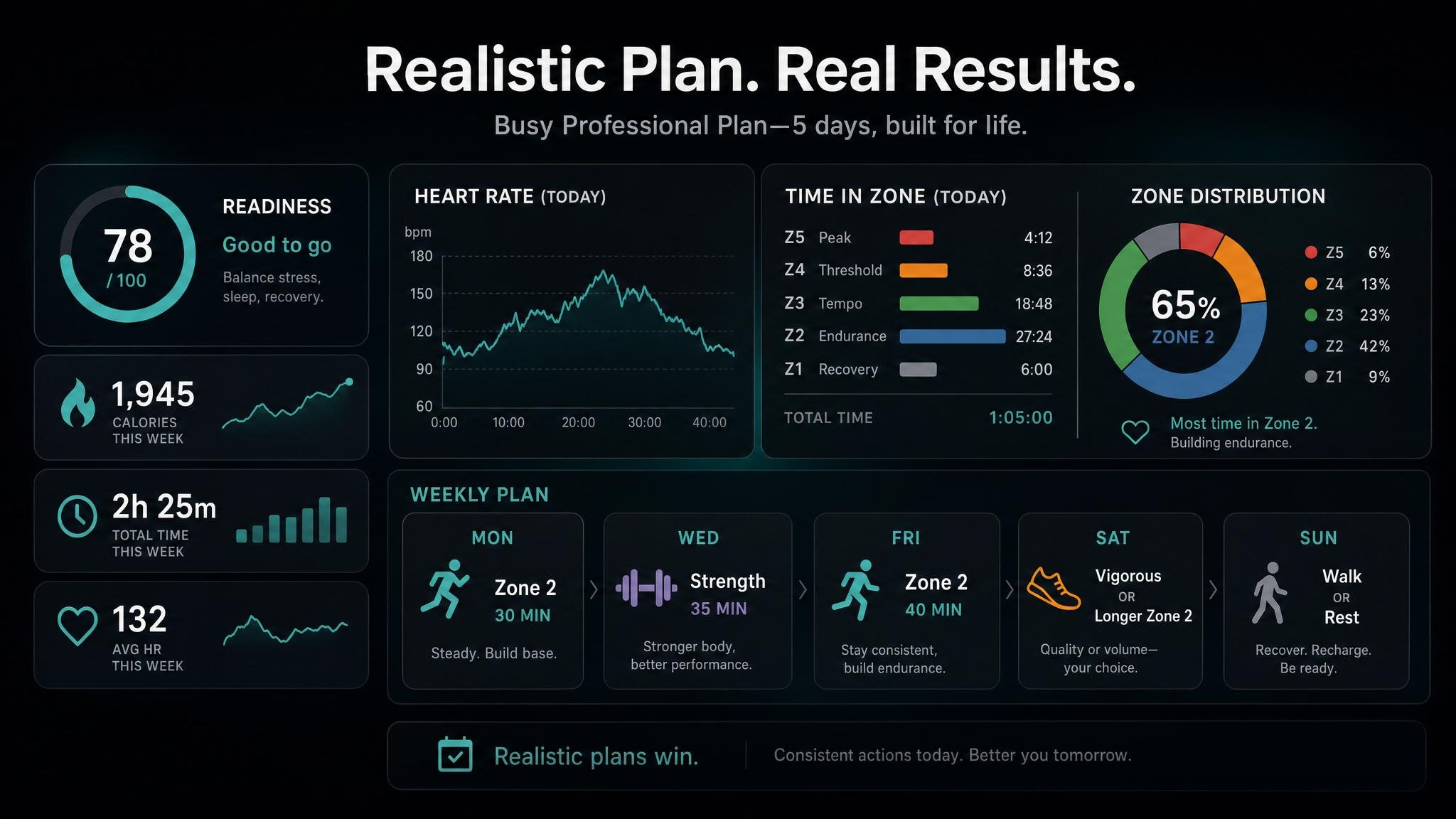
| Monday | Zone 2, 30 minutes |
| Wednesday | Strength, 35 minutes |
| Friday | Zone 2, 40 minutes |
| Saturday | Short vigorous session or longer Zone 2 |
| Sunday | Walk or rest |
This is not an endurance athlete's plan, but it is a realistic plan. Realistic plans win.
Progression should be boring. That is a compliment.
Do not start by raising intensity. Start by increasing consistency and duration. If you are doing two 30-minute Zone 2 sessions per week, build to three. If you are doing three 30-minute sessions, make one of them 40 minutes. If your long session is 60 minutes and feels easy for several weeks, move toward 70 or 75.
A conservative progression:
| Phase | Focus | Example |
|---|---|---|
| Weeks 1-2 | Establish baseline | 2-3 sessions of 20-40 minutes |
| Weeks 3-4 | Add frequency | Add one short Zone 2 session |
| Weeks 5-6 | Add duration | Extend one session by 10-15 minutes |
| Weeks 7-8 | Add quality if needed | Add one controlled hard session |
Use recovery markers:
| Marker | Green flag | Red flag |
|---|---|---|
| Sleep | Normal or better | Worse sleep after easy sessions |
| Motivation | Willing to train | Dreading easy workouts |
| Resting heart rate | Stable | Unusually elevated |
| Easy pace or power | Stable or improving | Falling despite effort |
| Soreness | Mild or none | Persistent heavy legs |
You do not need every metric to be perfect. But if several red flags show up, reduce duration or total weekly load.
Zone 2 progress is subtle. You will not always feel a dramatic breakthrough. Look for these signs:
| Sign | What it means |
|---|---|
| Same heart rate, faster pace or higher power | Aerobic efficiency is improving |
| Same pace or power, lower heart rate | The work costs less |
| Less heart-rate drift | Better durability and heat or fuel management |
| Easier recovery after long sessions | Better tolerance for aerobic volume |
| Better quality in hard workouts | Easy work is supporting the whole plan |
| More weekly consistency | The plan is sustainable |
Do not test progress every day. Compare similar routes, conditions, and durations every few weeks. If the weather changes from cool spring to hot summer, your pace may slow even if fitness improves. If you run a hilly route one week and a flat route the next, the numbers are not directly comparable.
One useful check is a steady aerobic benchmark:
The goal is not to force improvement. It is to observe whether easy aerobic work is becoming more economical.
Zone 2 can support weight loss, but not because it unlocks a special fat-burning shortcut.
The benefit is behavioral and physiological. Zone 2 is repeatable, can be done for meaningful durations, usually does not trigger the same recovery demand as hard intervals, and can fit into a weekly routine. It can help increase total energy expenditure while preserving energy for work, family, sleep, and strength training.
The mistake is confusing "higher percentage of fat used during exercise" with "more body fat lost over time." During lower-intensity exercise, fat may provide a larger share of fuel. At higher intensity, carbohydrate supplies more of the energy. But long-term fat loss depends on energy balance, nutrition quality, appetite, sleep, stress, and adherence.
If weight loss is the goal, use Zone 2 as the cardio you can repeat. Pair it with a realistic nutrition plan and strength training. Avoid turning every session into a sufferfest, because that often reduces consistency.
Zone 2 is often marketed as longevity training. The honest version is this: regular aerobic activity and higher cardiorespiratory fitness are strongly associated with better long-term health outcomes, and Zone 2 is one practical way to build aerobic fitness.
The overreach is saying Zone 2 itself has unique longevity effects proven beyond other forms of exercise. That evidence does not exist in the clean way the internet sometimes implies. Long-term health is affected by total physical activity, vigorous activity, strength, diet, sleep, smoking, blood pressure, lipids, glucose control, social context, and medical care.
Cardiorespiratory fitness is still worth taking seriously. The overview of meta-analyses on CRF and health outcomes found strong, consistent associations between higher fitness and lower risk across many outcomes (PMC). Zone 2 helps because it gives many people a way to train cardiorespiratory fitness without needing constant high-intensity sessions.
For longevity-focused training, a balanced week usually beats a single-zone obsession:
| Component | Why it matters |
|---|---|
| Zone 2 or moderate aerobic work | Builds repeatable aerobic fitness |
| Vigorous work if appropriate | Provides stronger intensity stimulus |
| Strength training | Supports muscle, bone, and function |
| Mobility and balance | Supports movement quality and aging well |
| Recovery | Lets adaptations happen |
Zone 2 and high-intensity interval training are not enemies. They answer different questions.
Zone 2 asks: How much aerobic work can I repeat consistently without excessive fatigue?
HIIT asks: How can I create a strong intensity stimulus in a shorter session?
Research on interval training shows that higher-intensity work can improve VO2max and mitochondrial content, sometimes with less total time than traditional moderate continuous training (PubMed). That is useful, especially for time-limited people. But HIIT is harder to recover from, harder to dose, and often less approachable for beginners.
A practical blend:
| Goal | Zone 2 role | HIIT role |
|---|---|---|
| General health | Main repeatable aerobic base | Optional 1 session weekly if safe |
| Running endurance | Most easy volume | Small amount for speed and VO2max |
| Cycling performance | Long aerobic rides | Intervals for power and race demands |
| Fat loss | Sustainable calorie expenditure | Optional time-efficient stimulus |
| Beginner fitness | Start here | Add later when base improves |
If you only have time for one type, choose the one you will do consistently and safely. If you can include both, Zone 2 usually forms the base and HIIT provides the sharp edge.
Most healthy adults can benefit from regular aerobic exercise, but not everyone should jump into a new program without context. If you have chest pain, unexplained shortness of breath, fainting, known cardiovascular disease, uncontrolled blood pressure, significant metabolic disease, or you are returning after a major illness, talk with a qualified clinician before increasing exercise intensity.
Medications can also change heart-rate response. Beta blockers, some calcium channel blockers, stimulants, thyroid medication, and other drugs may make heart-rate zones less reliable. In those cases, perceived effort, breathing, clinical guidance, and supervised exercise prescription may matter more than watch zones.
If Zone 2 produces unusual symptoms, stop and get appropriate care. Easy aerobic training should not feel dangerous.
Zone 2 is one type of cardio. Cardio simply means cardiorespiratory exercise: running, cycling, swimming, rowing, walking, hiking, or similar activity that raises heart rate and breathing. Zone 2 specifies a controlled aerobic intensity within that broader category.
It is a form of aerobic training, but not all aerobic training is Zone 2. Very easy Zone 1 work is aerobic. Moderate tempo can still be aerobic but may sit above Zone 2. The aerobic system contributes at almost every intensity; the question is how hard the session is and which adaptations you are targeting.
A common estimate is 60-70% of maximum heart rate, but this can be wrong for individuals. Heart-rate reserve, lab testing, the talk test, and perceived effort can all refine the estimate. Use the Zone 2 Heart Rate Calculator as a starting point, then check whether the result feels conversational and sustainable.
Yes, but many people have the opposite problem. If you can sing easily, feel almost no training effect, and your heart rate is far below your estimated range, the session may be Zone 1 rather than Zone 2. That can still be useful for recovery, but it may not be enough if your goal is aerobic development. Move up gradually while keeping breathing controlled.
Yes. If you can only speak in short phrases, if your legs burn, if heart rate climbs quickly at steady output, or if the workout compromises the next day, you are probably above Zone 2 or doing too much duration.
Most beginners can start with two or three days per week. Recreational athletes often use three or four. Endurance athletes may do Zone 2 or easy aerobic work most training days, with harder sessions placed deliberately. The right answer depends on total weekly load and recovery.
If strength is the priority, lift first and do shorter Zone 2 afterward, or separate them by several hours. If aerobic fitness is the priority, do Zone 2 first or on a separate day. For longer Zone 2 sessions, separate days are usually cleaner.
It can be. For some people, brisk walking is Zone 2. For fitter people, flat walking may be Zone 1 unless it is fast, uphill, loaded, or long. Use breathing, heart rate, and perceived effort rather than the activity label.
Usually because your aerobic system is still developing, your heart-rate zones are set too low, conditions are hot, terrain is hilly, or you are carrying fatigue. If the effort is correct, slow pace is not a problem. It is the starting point.
No, but it can help. Wrist sensors are convenient but can be inaccurate during motion, cold weather, poor fit, or high cadence. A chest strap is often more reliable. If your watch data does not match your breathing, verify the sensor before changing the whole plan.
For short sessions under about 45-60 minutes, many people do not need special fueling beyond normal meals and hydration. For longer sessions, especially if you are training for endurance performance, carbohydrate can help preserve quality and reduce stress. Zone 2 does not require fasted training.
Not automatically. Fasted training may increase fat oxidation during that session, but that does not guarantee better fat loss or better endurance adaptation. It can also reduce workout quality or increase stress for some people. Use fasted sessions only if they fit your body, goals, and schedule.
You may feel easier breathing within a few weeks, but meaningful aerobic changes usually take months of consistent training. Look for trends: lower heart rate at a given pace, faster pace at the same heart rate, less drift, and better recovery.
Some trained athletes can do easy aerobic work most days. Beginners usually should not start there. Daily Zone 2 can still become too much if sessions are long, impact-heavy, or layered on top of strength and hard intervals. Build gradually.
Not universally. Zone 2 is better for repeatable aerobic volume with lower fatigue. Zone 3 can be useful for tempo, race-specific work, and certain endurance goals, but it is easier to overuse. The mistake is not doing Zone 3; the mistake is accidentally turning every easy day into Zone 3.
No. It is a useful tool for many people, but the best exercise mix depends on goals, time, health status, preference, and training history. A strong program can include Zone 2, higher-intensity cardio, strength training, mobility, and enough recovery.
Zone 2 training is steady, controlled aerobic work near the upper end of easy. It is valuable because it is repeatable. It helps you accumulate aerobic volume, improve endurance, support harder workouts, and build a sustainable fitness habit. It can contribute to mitochondrial, cardiovascular, and metabolic adaptations, but it is not the only intensity that does so.
Use heart-rate estimates as a starting point, not a law. Cross-check them with the talk test, breathing, perceived effort, and workout repeatability. If the session feels like a race, slow down. If it feels like nothing, nudge it up. If your goal is health, use Zone 2 to build regular moderate activity. If your goal is endurance performance, use Zone 2 as the base layer under more specific training.
The best version of Zone 2 is not complicated. Pick a modality, find an effort you can sustain while talking, repeat it consistently, and adjust as your body adapts. Over time, that simple work can become one of the most powerful parts of your training.

