


Zone 3 is not bad for endurance training, but too much accidental Zone 3 can crowd out easy aerobic volume and make hard sessions worse. Learn when tempo helps and how to audit your weekly balance.

Zone 3 is not bad for endurance training. It is useful when it is planned tempo, progression, race-specific, or hill work. The problem is not Zone 3 itself. The problem is spending so much time there that your easy sessions stop being easy and your hard sessions stop being high quality.
That is why Zone 3 gets called "junk miles" or "gray-zone training." Those labels are too blunt. A Zone 3 run, ride, row, or hike can be productive. But if most of your week lives at a moderate effort that feels purposeful without being truly hard, you can accumulate fatigue faster than fitness.
The practical answer is this: Zone 3 is good as a dose and risky as a default. Use it when it supports a specific goal. Be cautious when it happens by accident because every easy day drifted upward.
In the common five-zone heart-rate model, Zone 3 usually means moderate or tempo intensity. It often sits above easy conversational work and below threshold-style work. You can hold it for a while, but it is no longer relaxed. Breathing is more purposeful, talking becomes shorter, and the session has a clear training cost.
This article uses that five-zone meaning because it is what most watches and apps show. Research papers often use a three-zone model instead: low intensity below the first lactate or ventilatory threshold, threshold or heavy work between the first and second thresholds, and high intensity above the second threshold. Seiler's review of endurance training organization discusses this threshold-based model and why successful endurance athletes often keep most training below the first threshold (PubMed).
That distinction matters. When a coach says "avoid too much Zone 3," they usually mean avoid too much moderate tempo work in a five-zone app. They do not mean that all moderate aerobic exercise is unhealthy or useless.
Zone 3 gets criticized because it is easy to overuse. It feels productive. It gives faster pace, higher power, and more satisfaction than Zone 2. It is also easier to choose than true intervals because it is hard enough to feel like work but not so hard that you need precise structure.
The hidden cost is recovery. A week full of Zone 3 can make easy days less restorative and hard days less sharp. For runners, it can also add mechanical stress because moderate pace often means more impact than truly easy running. For cyclists, rowers, and swimmers, impact may be lower, but metabolic fatigue still accumulates.
This is where the "easy days easy, hard days hard" idea comes from. Reviews of well-trained and elite endurance athletes show that a large share of training is often done at low intensity, with smaller doses of threshold and high-intensity work layered on top (Frontiers in Physiology). That pattern does not prove every recreational athlete needs an elite distribution, but it explains why accidental moderate training can become a problem when total volume rises.
The evidence does not say that Zone 3 is forbidden. It says that endurance training usually works better when intensity is distributed deliberately.
Several intervention studies support the idea that trained endurance athletes often benefit from keeping most training low intensity while reserving smaller amounts for harder work. Stoggl and Sperlich compared polarized, threshold, high-intensity, and high-volume training concepts in well-trained endurance athletes and found that polarized training improved several key endurance variables over the study period (Frontiers in Physiology). Neal and colleagues reported that six weeks of polarized training led to greater physiological and performance adaptations than a threshold-heavy model in trained cyclists (Journal of Applied Physiology).
Running research points in the same general direction, with nuance. Esteve-Lanao and colleagues studied subelite endurance runners and found that the distribution of training intensity affected performance outcomes over a multi-month period (PubMed). The broader lesson is not that every runner needs one exact split. It is that the mix of easy, moderate, and hard work matters.
There is also disagreement and limitation in the literature. A systematic review and meta-analysis comparing polarized and threshold training found that polarized approaches may be beneficial, but outcomes depend on study design, athlete level, duration, and how intensity zones are defined (Journal of Strength and Conditioning Research). So the right takeaway is conservative: avoid letting moderate intensity dominate by accident, but do not treat Zone 3 as poison.
Zone 3 can be valuable when it has a job.
Tempo work helps you practice sustained controlled pressure. Marathon runners, half-marathon runners, cyclists preparing for steady climbs, triathletes, and hikers on long grades may all need time at moderate effort. Race-specific training often includes work that is not fully easy and not maximal. If your goal event asks you to live near that intensity, some Zone 3 exposure is reasonable.
Zone 3 can also be useful in progression workouts. You might start easy, build through Zone 2, and finish with a controlled Zone 3 segment. That can teach pacing without the recovery cost of a full threshold session. Hilly terrain can also push parts of a workout into Zone 3 even when the overall session is intended to stay aerobic.
For general health, moderate-intensity aerobic activity is clearly valuable. The WHO recommends 150-300 minutes per week of moderate-intensity aerobic activity, 75-150 minutes of vigorous activity, or an equivalent mix for adults (NCBI Bookshelf). The CDC's talk test describes moderate intensity as an effort where you can talk but not sing (CDC). That overlaps with the lower to middle part of many people's five-zone systems. So Zone 3 is not automatically "bad" just because it is moderate.
Zone 3 becomes a problem when it replaces the two things most endurance programs need: enough easy aerobic volume and enough truly hard quality work.
The first warning sign is that your easy sessions keep drifting upward. You start a run intending to stay relaxed, but pace pride, hills, heat, or group pressure pulls you into Zone 3. The session still feels manageable, so you repeat it. After a few weeks, your log says you trained a lot, but your recovery says otherwise.
The second warning sign is flat hard workouts. If intervals, threshold sessions, or race-specific efforts feel worse than expected, your moderate days may be stealing freshness. Zone 3 is not as hard as Zone 4 or 5, but it is not free.
The third warning sign is that Zone 3 takes up a large share of the week while Zones 1 and 2 shrink. For many endurance athletes, a useful default is to keep most weekly time easy, then add smaller doses of moderate and hard work. A Zone 3-heavy week may be fine for a short, specific block. It is less useful as an unplanned year-round pattern.
Use weekly distribution before judging one workout. A single Zone 3 session is rarely the problem. The pattern is the problem.
For a general endurance week, a practical checkpoint is:
| Weekly pattern | What it usually means |
|---|---|
| Zones 1-2 are 70% or more and Zone 3 is 20% or less | Easy-led week with a controlled tempo dose |
| Zone 3 is above 25% and Zones 1-2 are below 70% | Zone 3 may be crowding out easy work |
| Zones 4-5 are high and easy time is low | Hard-intensity-heavy week, useful only if recovery supports it |
| Zone 3 is high during a planned race-specific block | Possibly fine, but it should be intentional |
Use the checker below to make the tradeoff visible. You can also open the standalone Zone 3 Training Balance Checker when you want to audit a week from your training log.
Related
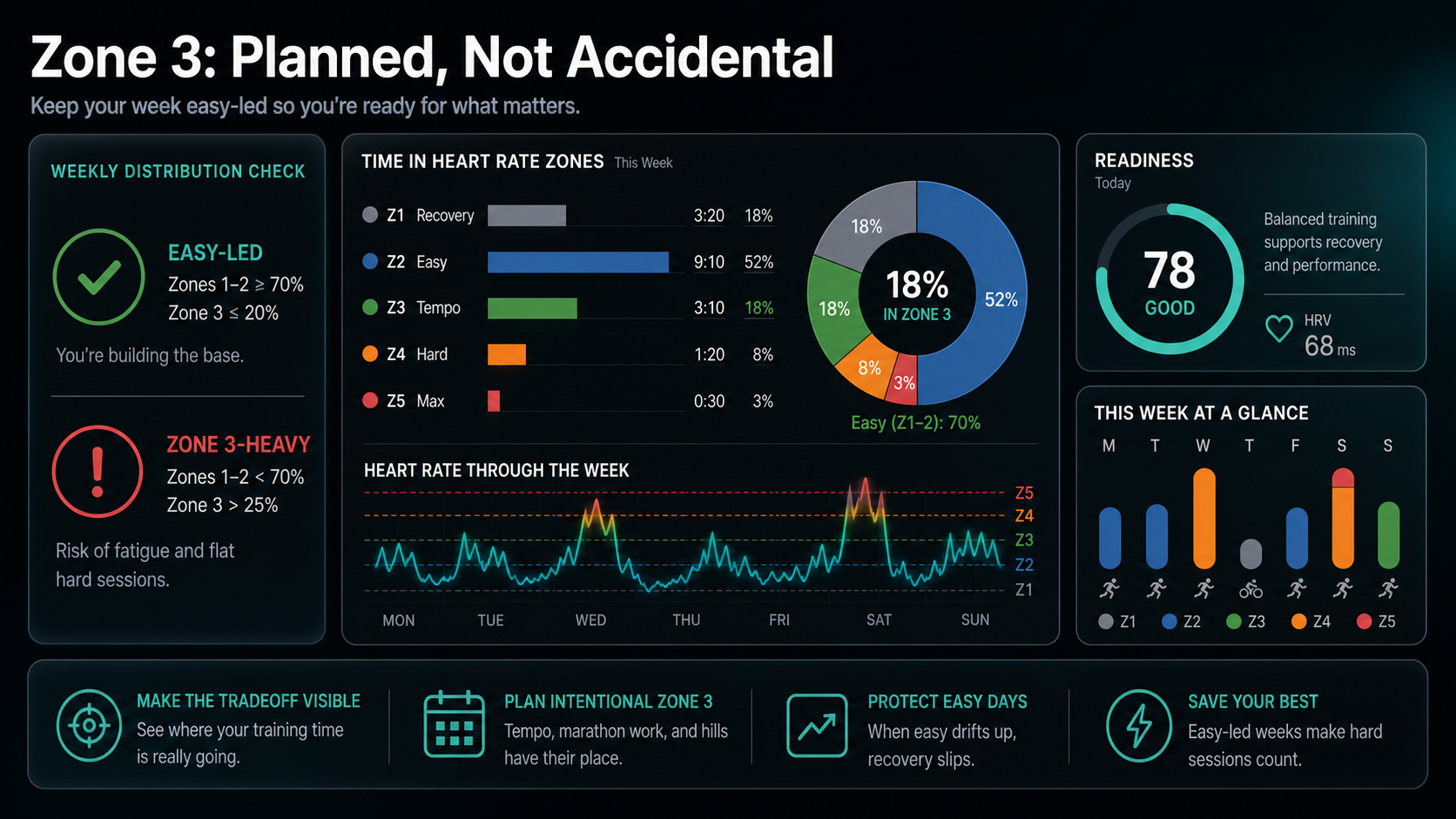
The tool uses simple guardrails, not universal laws. A marathon-specific block, long hill workout, or tempo-focused phase can deliberately include more Zone 3. But if the checker flags Zone 3-heavy weeks several times in a row and you are not recovering well, that is useful feedback.
The fix is usually simple, but not always easy.
First, lower the ceiling on easy days. Use heart rate, power, pace, breathing, or the talk test. If the workout is supposed to be easy, keep it easy enough that you can finish feeling like you could continue. If small hills keep pushing you into Zone 3, slow down, walk briefly, or choose flatter terrain for true easy sessions.
Second, make hard days more deliberate. Instead of letting every workout become moderately hard, choose one or two quality sessions and make them specific. That might be threshold intervals, VO2max intervals, hill repeats, race-pace work, or a structured tempo session. The rest of the week should support those sessions rather than compete with them.
Third, do not panic about brief Zone 3 spikes. Warm weather, stairs, hills, caffeine, sleep loss, and sensor noise can all move heart rate. A few minutes in Zone 3 during an easy workout is not failure. The concern is a repeated pattern where easy time disappears.
Finally, review weeks, not moods. A workout can feel satisfying because it was a little too hard. A training plan works because the whole week fits together.
For a recreational endurance athlete training 4 to 6 hours per week, a sensible starting point might look like this:
| Session | Purpose | Intensity |
|---|---|---|
| Easy aerobic session | Build repeatable volume | Zones 1-2 |
| Quality workout | Threshold, intervals, or tempo | Planned Zone 3-5 |
| Easy aerobic session | Recovery-friendly endurance | Zones 1-2 |
| Longer endurance session | Durability and aerobic base | Mostly Zones 1-2, small Zone 3 if terrain requires |
| Optional short easy session | Extra volume if recovered | Zones 1-2 |
This is not a prescription. It is a pattern: most time easy, some intensity planned, Zone 3 used deliberately. If you train less than 3 hours per week, you may need a higher proportion of moderate work to get enough stimulus. If you train more than 8 hours per week, easy intensity usually becomes more important because hard work does not scale endlessly.
Zone 3 is not bad for endurance training. It is bad only when it becomes the accidental default and crowds out the rest of the plan.
Use Zone 3 for tempo, progression, race-specific work, hills, and controlled moderate sessions. Keep easy days genuinely easy when they are meant to build aerobic volume or support recovery. Then check the weekly pattern: if most of your time is still easy and your hard sessions are improving, Zone 3 is probably doing its job. If Zone 3 dominates week after week and recovery is slipping, the fix is not more discipline at moderate effort. It is a clearer split between easy, planned moderate, and truly hard training.


