Most athletes can feel early aerobic base changes in a few weeks, but a durable base usually takes months. Learn the realistic timeline, what changes first, and how to know your base is improving.

Most athletes can feel early aerobic base changes within 2 to 4 weeks of consistent training. Easy sessions start to feel smoother, heart rate may settle faster after the warm-up, and routine workouts may stop leaving as much soreness. Measurable fitness trends usually become clearer after 6 to 8 weeks. A useful aerobic base often takes 8 to 12 weeks. A deep base for long races, higher volume, or demanding endurance goals can take 3 to 6 months or longer.
That answer is more honest than a single number because "building a base" can mean different things. A beginner may call it a base when they can train three or four times per week without feeling wrecked. A marathon runner may mean holding a long run without heart-rate drift. A cyclist may mean adding hours while keeping most work easy. A trained athlete may mean improving durability enough that harder work becomes more productive.
The underlying physiology is also layered. Endurance training improves the systems that deliver oxygen, use oxygen, regulate fuel, and sustain movement. Jones and Carter describe endurance training as improving parameters such as VO2max, lactate or ventilatory threshold, exercise economy, and oxygen uptake kinetics Jones and Carter, 2000. Those qualities do not all change at the same speed.
The practical goal is not to wait for a perfect base before doing anything else. The goal is to build enough low-cost aerobic capacity that you can train consistently, recover reliably, and add harder work without turning the whole week into fatigue management.
A simple timeline works for most endurance athletes:
This is a planning range, not a guarantee. In a classic 10-week endurance-training study, Hickson, Bomze, and Holloszy found rapid gains in VO2max and endurance when subjects trained hard six days per week, with VO2max increasing even in the first week Hickson et al., 1977. That study used strenuous training, not a gentle base block, so it should not be copied as a beginner plan. It does show that measurable aerobic changes can happen within weeks when the training stimulus is consistent.
For base training, the more useful question is not "How fast can fitness change?" It is "How long until the fitness is repeatable and durable?" That usually takes longer than the first noticeable improvement.
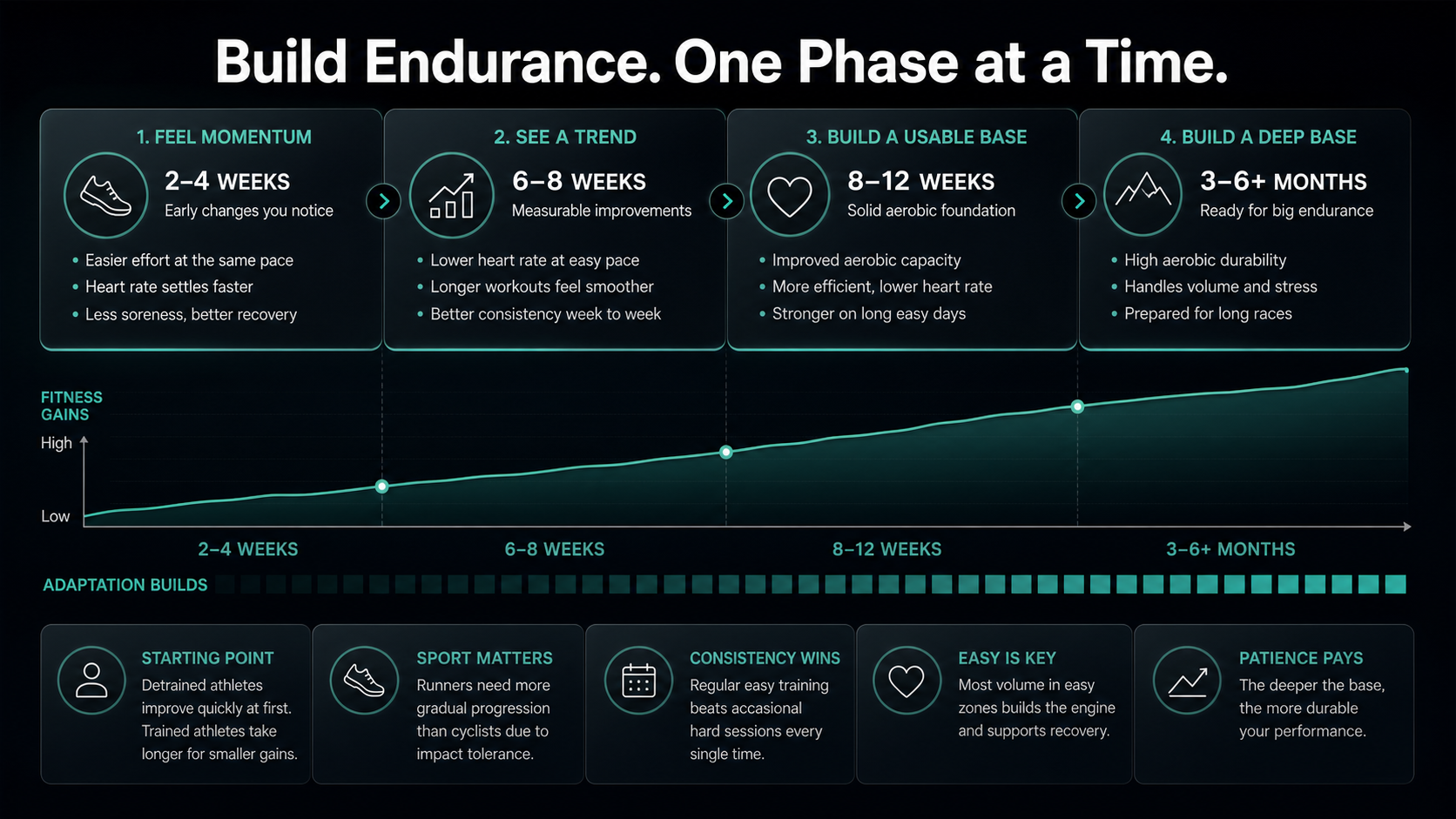
Your starting point matters more than the calendar. A detrained athlete often improves quickly because consistent aerobic work is a new stimulus. A trained athlete may need more weeks for smaller gains because the easy improvements have already been earned. A runner may need a slower progression than a cyclist because tendons, bones, and muscles must adapt to impact, not just the heart and lungs.
Training frequency matters too. Three short sessions per week can build a base, especially for beginners, but progress will look different from five or six well-controlled sessions. Duration matters because base training is partly about accumulating low-cost work. Intensity matters because sessions that are too hard may feel productive today but reduce the amount of training you can repeat tomorrow.
Recovery also shapes the timeline. Sleep, fueling, stress, and strength work all affect whether aerobic training turns into adaptation or just fatigue. The American College of Sports Medicine's exercise prescription guidance emphasizes that exercise programs should be adjusted to the person's current activity, health, responses, and goals ACSM Position Stand, 2011. That principle applies cleanly to aerobic base work: the right timeline is the one your body can absorb.
The first improvements are often behavioral and cardiovascular rather than dramatic race-fitness changes. You learn what easy actually feels like. Your warm-up becomes more predictable. You stop surging on hills. You finish sessions with less residual fatigue.
Some physiological changes can also begin early. Endurance exercise triggers metabolic and molecular remodeling in skeletal muscle, and those signals accumulate with repeated sessions Egan and Zierath, 2013. But the first thing you notice may be simpler: you can repeat the same run, ride, hike, or row with less emotional and physical cost.
That matters. Aerobic base training works because it stacks repeatable sessions. If your first month mainly teaches you to train easy enough to come back tomorrow, that is not wasted time. It is the start of the base.
Common early signs include:
These signs are not proof that your base is complete. They are proof that the training is starting to become sustainable.
After 6 to 8 weeks, patterns become easier to separate from noise. One good day can happen by chance. A month and a half of similar sessions gives you enough data to see whether the trend is real.
This is where many athletes notice that easy pace improves at the same heart rate, or the same power requires less effort. Longer sessions may feel less intimidating. Recovery between workouts may become more predictable. Heart-rate drift may decrease on steady endurance sessions under similar conditions.
The 6-to-8-week point is also where you can judge whether your progression is too aggressive. If you added volume but your easy heart rate is rising, mood is worse, sleep is worse, and every workout feels like work, you are not building a base efficiently. You are accumulating fatigue.
For trained athletes, 6 to 8 weeks may be enough to sharpen a trend but not enough to transform the base. Stoggl and Sperlich found meaningful changes in well-trained endurance athletes over a 9-week intervention, but the response depended on the training-intensity model Stoggl and Sperlich, 2014. That is a useful reminder that time alone is not the plan. The distribution of intensity and recovery matters.
Eight to 12 weeks is long enough for many athletes to build a base they can use. It gives you time to establish frequency, lengthen one or two sessions, collect enough trend data, and make mistakes without the whole block being lost.
For a new runner, that may mean moving from inconsistent workouts to three or four weekly runs that feel controlled. For a cyclist, it may mean adding endurance volume while keeping most rides in easy zones. For a hiker, it may mean longer steady outings and better uphill breathing. For a returning athlete, it may mean rebuilding consistency before race-specific training.
This length also leaves room for gradual progression. Most base blocks should not jump straight to the target volume. A simple pattern is to build for two or three weeks, then hold or reduce slightly for a recovery week. Repeat that cycle two or three times and you have a practical 8-to-12-week base phase.
The point is not that adaptation stops at week 12. It does not. The point is that 8 to 12 weeks is often enough time to build a foundation that changes what training you can handle next.
A deep base takes longer when the goal demands more durability. Half marathon, marathon, gravel, triathlon, ultrarunning, long hikes, ski touring, and multi-hour cycling events all reward the ability to keep moving after the easy part of the workout is over.
Three to 6 months may be more realistic if you are trying to:
Elite and well-trained endurance athletes often organize a large share of training at low intensity because it is the intensity range that can be repeated in high volume. Seiler's review of endurance training intensity distribution describes successful athletes as commonly performing most sessions at low intensity while adding smaller amounts of high-intensity work Seiler, 2010. That does not mean recreational athletes must copy elite volume. It does show why a real base is built over many weeks of controlled work, not one heroic month.
Beginners usually need 8 to 12 weeks to build a usable aerobic base. The early goal is not speed. It is consistency, tissue tolerance, and learning to keep easy days easy. If you are starting from very low fitness, even 20 to 40 minutes of controlled aerobic work can be enough at first.
Returning athletes often feel better within 2 to 4 weeks but should still plan 6 to 10 weeks before assuming the base is back. Previous training history helps, but connective tissue, recovery habits, and weekly rhythm still need rebuilding.
Intermediate athletes often need 8 to 16 weeks, depending on how much gray-zone training they have been doing. If most sessions have been medium-hard, the first base-building job may be learning to slow down. Once easy work becomes truly easy, volume can rise more safely.
Advanced athletes may need 3 months or more for a base block to create meaningful change. Their improvements are smaller and harder to detect. The goal may be less about a dramatic VO2max jump and more about durability, freshness, and the ability to absorb race-specific work.
Masters athletes should usually think in longer timelines. That does not mean progress is slow by default. It means recovery cost deserves more respect. A slightly slower build that stays consistent usually beats a fast build interrupted by soreness or forced rest.
The best signs are repeatable, not dramatic.
First, look at easy effort. If the same route at the same perceived effort gradually becomes faster, that is progress. If the same pace produces a lower heart rate under similar conditions, that is progress too.
Second, look at heart-rate drift. During a steady aerobic session, your heart rate will often rise over time. Some drift is normal, especially in heat or dehydration. But if drift decreases across similar long sessions, your endurance durability may be improving.
Third, look at recovery. A stronger base should make ordinary aerobic work feel less costly. You should be able to train again without needing to negotiate with yourself.
Fourth, look at weekly consistency. If you can complete more weeks with fewer interruptions, you are building the most important base quality: repeatability.
Fifth, look at long-session stability. A base is not just a faster first hour. It is the ability to keep form, breathing, mood, and pacing under control later in the session.
Avoid over-reading any single workout. Weather, terrain, sleep, caffeine, hydration, and life stress can all distort the numbers. Use trends from similar sessions.
Reassess after 6 to 8 weeks if you are using the block to decide what to do next. That is usually enough time to compare similar sessions and see whether your easy aerobic work is trending in the right direction. You do not need a lab test, but you do need a repeatable reference.
One simple option is a steady aerobic benchmark on the same route, bike setup, treadmill, indoor trainer, or rowing machine. Keep the effort controlled, then compare average heart rate, pace or power, perceived effort, and how you feel the next day. Another option is to review a normal long session and look for less late-session drift at a similar output.
If you have access to formal testing, lactate or ventilatory thresholds can help you update zones, but testing is not mandatory. The main endurance qualities still interact: VO2max, threshold, economy, and oxygen uptake kinetics all influence performance Jones and Carter, 2000. A single test number can be useful, but it should not override the training record.
If the data are mixed, extend the base phase rather than rushing into harder work. A base is ready when it changes what you can repeat, not just what you can do once.
There is no universal minimum, but the base-building stimulus needs to be frequent enough to repeat. For general health, ACSM's position stand recommends at least 150 minutes per week of moderate-intensity cardiorespiratory exercise for most adults, or a smaller amount of vigorous exercise, with programs adjusted to the individual ACSM Position Stand, 2011. Endurance performance goals often require more specificity than public-health guidelines, but that 150-minute benchmark is a useful reference point for consistency.
For a beginner, three sessions per week may be enough to start. For a recreational endurance athlete, four to six aerobic touchpoints per week can work well if recovery is good. For higher goals, total weekly volume and long-session duration become more important, but only after the easy work is actually easy.
The safest progression is usually frequency first, then duration, then intensity. Add days carefully. Add minutes gradually. Add harder work only when it improves the week instead of compromising it.
Yes. Aerobic adaptations need a continuing stimulus. The timeline for losing fitness varies, but detraining research shows that some changes can begin quickly when training stops.
Mujika and Padilla reviewed detraining in humans and reported that recently acquired VO2max gains can be lost after training stoppages longer than 4 weeks, while some metabolic changes can appear sooner Mujika and Padilla, 2001. In a companion review on muscular detraining, they noted that capillary density may decline within 2 to 3 weeks of inactivity and oxidative enzyme activity can fall with continued training cessation Mujika and Padilla, 2001.
That does not mean one missed week destroys your base. It means consistency matters. A short deload can help you adapt. A long period with too little stimulus gradually erodes the qualities you built.
If you take time off, rebuild with the same logic you used the first time: frequent easy work, controlled progression, and patience.
Here is a simple model for a runner, cyclist, hiker, rower, or general endurance athlete. Adjust the days and durations to your sport and history.
Weeks 1 to 4 are for rhythm. Keep most sessions easy. Add frequency only if you are recovering well. Finish workouts feeling like you could have done more.
Weeks 5 to 8 are for steady progression. Extend one aerobic session. Keep the other sessions controlled. Watch heart-rate drift, soreness, and motivation. If everything feels harder, hold volume instead of forcing the plan.
Weeks 9 to 12 are for durability. Keep most work easy, but make the long session or total weekly volume specific to your next goal. If you are stable, add small touches of faster work such as relaxed strides, short hills, cadence drills, or one controlled quality session.
The outline is intentionally boring. Boring is useful here. Base training is not built by novelty. It is built by enough repeated aerobic work to make the body trust the workload.
The first mistake is training too hard on easy days. This turns a base phase into a fatigue phase. You may feel productive for two weeks, then stall.
The second mistake is adding volume faster than your tissues can handle. Cardiovascular fitness can improve before tendons, bones, and muscles are ready for the same workload. Runners should be especially careful with this gap.
The third mistake is changing everything at once. New shoes, new routes, new strength work, more volume, and stricter nutrition can make it hard to know what is helping or hurting.
The fourth mistake is under-fueling. Base training may improve fat oxidation over time, but that does not mean every session should be depleted. You need enough energy to adapt.
The fifth mistake is expecting linear progress. Fitness may improve in steps. Some weeks consolidate. Some weeks are affected by heat, sleep, or life stress. The goal is not perfect weekly improvement. It is a better trend across the block.
Building an aerobic base takes weeks to notice and months to deepen. A realistic timeline is 2 to 4 weeks for early momentum, 6 to 8 weeks for clearer trends, 8 to 12 weeks for a usable base, and 3 to 6 months or longer for a deep base that supports long events or higher training volume.
The exact timeline depends on your starting point, sport, consistency, recovery, and definition of "built." The best base is not the one created fastest. It is the one that lets you train more consistently, recover more reliably, and handle the next phase of training with less strain.
Keep most aerobic work controlled, progress gradually, measure trends instead of single workouts, and give the process enough time to compound. That is how base training turns from a few easy sessions into durable endurance.
Related